Showing posts with label Social media. Show all posts

Saturday, April 23, 2011

On networks [Note to self]

Aah, networking the buzz word of the last ten years that just won't die. I hate networking. It is stupid and a very unpleasant process. Talking to people you do not even like just because you want to be part of their network and expect to gain something from this connection. It reduces human contact to just pursuit of personal benefit. That's not cool.

Anyways the concept of networks and how they operate is a very interesting topic. Recently I saw a documentary about the structure of networks and it was pretty damn interesting. Here are some ideas that I picked from it.

The main point of the documentary was that networks seem to have a few universal rules that they follow. It seems that all the participants of a network are really just a few hops away from each other and that the six degrees of separation is not a myth after all. This pattern can be seen in social networks, electrical networks and even in biological organisms.

Why isn't "six degrees of separation" total myth. Well any network follows a pattern where most of the members of the network only have a few connections. Second point is that, for example, in a social network members usually are connected to the same people, think of your circle of friends, you all know each other. But if one point of a network has a connection to a point far away it can connect two clusters and create new connections within the network. Illustration please:
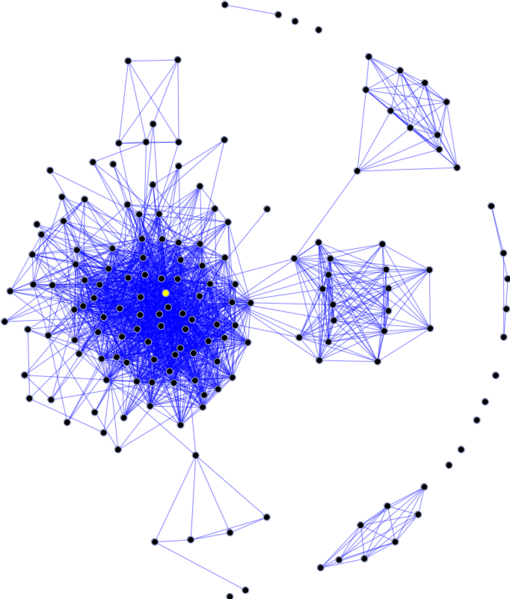

Social network diagram Source: Wikipedia

Usually these points of network that have connections to far away clusters have connections to other clusters as well. They can be described as being kind of a super cells (or nodes, or hubs) they connect the different clusters together. These super cells can be found in road networks, micro chips and human cells. The fact that clusters start to emerge seems to inevitable in a network. In fact all networks can be described with to attributes high connectivity and clusters There lies the strength and weakness of networks. Removing the major hubs (small nodes do not matter that much) will cause the network to collapse. It also means that, for instance, in the case of social media and networking in general, you want to try and become a hub of connections and it would be a mistake to focus on the people you already know. Only by becoming a hub you can ensure that your message spreads the farthest it can spread. (If that is what you want.)


You can find more information on different networks on Wikipedia.

Friday, July 2, 2010

My thoughts on social media

This week I participated to a training course that gave an overview on how to use social media in marketing. The course was reasonably interesting and I must say that I now know a bit more about how to utilize tools like Facebook and LinkedIn in marketing.

One lecture on the course handled the future. The lecturer presented a vision where social media and networks will penetrate to every field of our life. Let?s say that you are walking in the city center and would like to find a restaurant. You take your mobile phone from your pocket and it can recommend to you restaurants based on the places you have visited before, what your friends have recommended and so. The phone could give you the menu an how to get to the restaurant, maybe even make a table reservation and if your friends happen to be in near the phone may suggest that you ask them to join for dinner. This sort of services would apply everywhere and to everything. Computing would be ubiquitous.

For me this kind of vision sounds a bit pointless is the problem that is being solved with computing being everywhere all the time really that big. What is wrong with not knowing where you are, why don?t you want to explore new cities. What this ubiquitous computing becomes a straight jacket that instead of making us explore and try new things keeps us always in our comfort zone. I think that the best part of living is not knowing what becomes happens next, trying new things and challenging yourself every day. If people become so accustomed to being surrounded by technology that advises them in every situation, we might soon be living in world that Isaac Asimov drew up in his book ?Caves Of Steel?.

One crucial point of network is that it brings benefit to the participants. How does the situation change if network becomes too large and it is difficult to assess if someone is getting things without contributing anything. I also wonder that is it possible that the actual first signs no longer are seen in social media, but instead the first signs of trends will be seen in the IRL social networks of early adopters of new trends. What I mean that if when some new trend appears in social media it is already everywhere and known by everybody it becomes quite impossible to try and benefit from this emerging trend.

What happens when people do not want to share or wish to limit the network among which they wish to share information? Will we see new barriers and borders being raised so that people will able to protect their networks? Last week I read that the World Economic Forum has started an social media service for its participants. The service is called WELCOM and the participants of the service are 5000 of the most influential people in the world. Of course these people can not (but should they?) talk openly about what they think about where the world is going, so it is quite understandable that a service like WELCOM has been created.

Social media undoubtedly brings with it also good things. It will be easier to tell about new ideas and opportunities to the right people straight away. The rippling effect of your message may reach a lot more people than a normal marketing message and it will also be more accurate. There is also a great possibility to react to customer responses more efficiently and to develop your goods and services according what customers think.

I predict that the next phase in the evolution of social media will have something to do with assessing if this matters to you personally. The professionals, I believe, speak of semantic web.